Artist
ALAN SORRENTI
A very important artist from Naples, Alan Sorrenti released his first album in 1972 on Harvest. He had a Welsh mother and had spent much time in Wales as a child.
Aria is a very nice album, with two different sides: the first only contained the long title track, a dreamy suite starting with acoustic guitar and based on the marvellous instrument-like voice of Sorrenti, and exploding in the final part with a memorable violin solo by Jean Luc Ponty. Side 2 was softer, with three tracks, two of which also appeared on a single.
The album was successful, and Alan Sorrenti was one of the few solo artists to compete with prog groups in the open air festivals of the time. The album was also issued abroad, but with little success.
A second album, with the long title of Come un
vecchio incensiere all'alba di un villaggio deserto was released a year
later.
It was based on the same formula as Aria, but probably lacked the fresh
impact of its predecessor. Again a side-long title track opposed to some shorter and softer
tracks, this time with help from Francis Monkman (Curved Air) and Dave Jackson
(Van der Graaf Generator) along with percussionist Toni
Esposito.
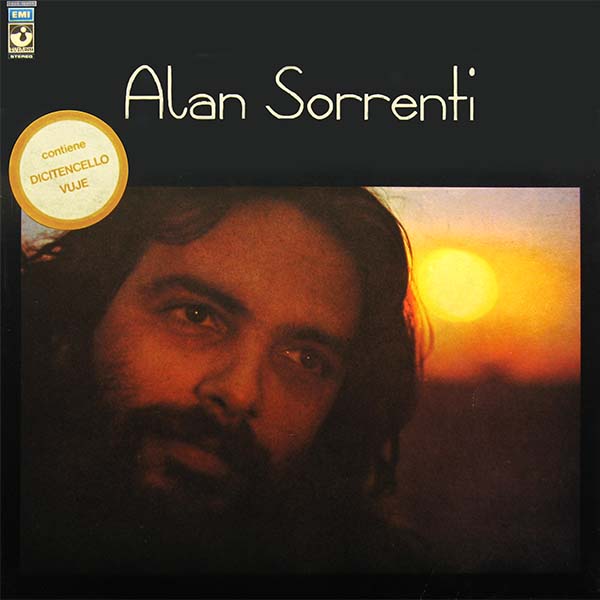
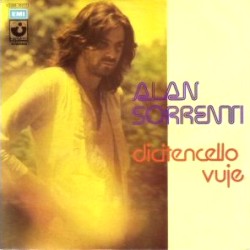
Third album is usually considered the least convincing of Alan's early production, despite some very good tracks, his style slowly shifting toward straight songs. The remake of the traditional neapolitan classic Dicitencello vuje, included on the album and also released as a single, was seen by his early fans as a treason, and while it gave very good sales and chart placement, it caused the artist to be boycotted in many summer festivals.
After a two year break a new Alan Sorrenti came back in 1976, with a more commercial style, influenced by dance music, and totally closing his past avantgarde experience. The last album in the long career of Alan Sorrenti was Sottacqua issued in 2003.

| LP (up to 1974) | |||
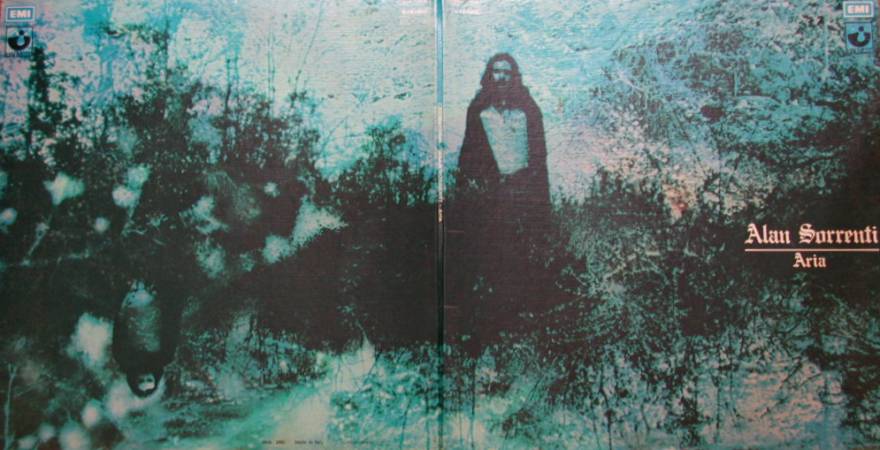
| Aria | Harvest (3C064-17836) | 1972 | gatefold textured cover with inner |
| Harvest (3C064-17836) | 1973 | as above with smooth cover | |
| Harvest (3C064-17836) | 1982 | reissue of the above with single cover | |
| AMS/BTF (AMS 19LP) | 2010 | reissue with gatefold cover and inner | |
| BTF (VM LP 180) | 2016 | reissue with gatefold cover and inner - green or orange vinyl | |
| Harvest/De Agostini (3C064-17836) | 2017 | gatefold cover with inner and 8-page insert - no.5 in the De Agostini "Prog Rock Italiano" series | |
| Harvest/Universal (60256 75623 44) | 2018 | gatefold cover with inner | |
| Come un vecchio incensiere all'alba di un villaggio deserto | Harvest (3C064-17878) | 1973 | single cover with glued 12-page booklet on front |
| BTF (VM LP 181) | 2016 | reissue with gatefold cover and gold vinyl | |
| Harvest/Universal (60256 75623 51) | 2018 | single cover with glued 12-page booklet on front | |
| Harvest/De Agostini (3C064-17878) | 2020 | gatefold cover with booklet and 8-page insert - no.70 in the De Agostini "Prog Rock Italiano" series | |
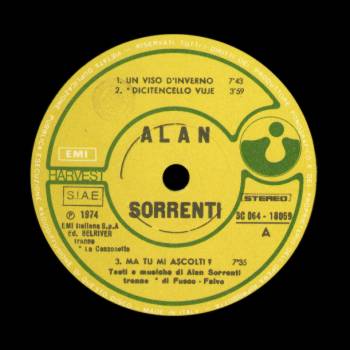
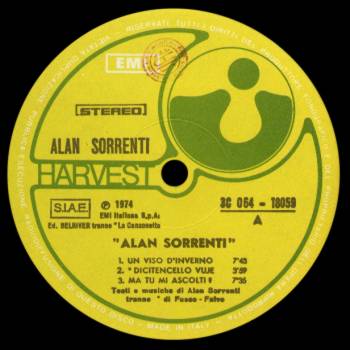
| Alan Sorrenti | Harvest (3C064-18059) | 1974 | single cover with inner - round sticker on shrink - two different label designs exist, standard and small |
| Harvest/Universal (60256 75623 68) | 2018 | reissue of the 1974 album - single cover with inner | |
CD |
|||
| Aria | Mellow (MMP 191) | 1994 | reissue of 1972 album - now deleted |
| Vinyl Magic (VM 071) | 2000 | as above - now deleted | |
| EMI (72438 60271 2) | 2005 | as above | |
| Water (WATER 180) | 2006 | as above | |
| EMI (50999 96549 2) | 2009 | mini-LP card cover with plastic CD tray | |
| Universal (06025 67533 054) | 2018 | mini-LP gatefold cover | |
| Come un vecchio incensiere all'alba di un villaggio deserto | Mellow (MMP 192) | 1994 | reissue of 1973 album - now deleted |
| Vinyl Magic (VM 076) | 2000 | as above, with bonus track Le tue radici, taken from 1974 single | |
| EMI (72438 60270 2) | 2005 | new reissue of 1973 album | |
| Universal (06025 67533 078) | 2018 | mini-LP gatefold cover | |
| Alan Sorrenti | Mellow (MMP 237) | 1995 | reissue of 1974 album - now deleted |
| EMI (72438 60268 2) | 2005 | as above | |
| Universal (06025 67533 08) | 2018 | mini-LP cover | |
| The prog years box | Universal (06025 67562 399) | 2018 | 5CD box set with the first four albums and a fifth CD with unreleased material |
SINGLES (with picture sleeve - up to 1974) |
|||
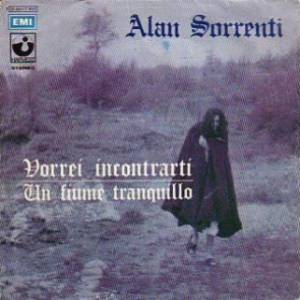
| Vorrei incontrarti Un fiume tranquillo |
Harvest (3C006-17852) | 1972 | both tracks from Aria |
| Universal (00602547286284) | 2015 | reissue of the above especially made for Record Store Day 2015 | |
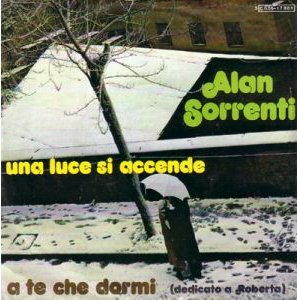
| Una luce si accende A te che dormi |
Harvest (3C006-17881) | 1973 | both tracks from Come un vecchio incensiere all'alba di un villaggio deserto |
| Dicitencello vuje Poco più piano |
Harvest (3C006-18017) | 1974 | both tracks from Alan Sorrenti |
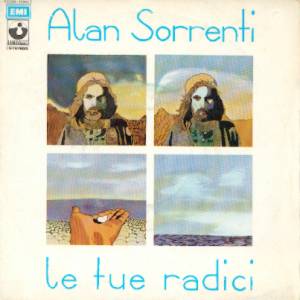
| Le tue radici part I & II |
Harvest (3C006-17983) | 1975 | both unreleased tracks |
PROMO-ONLY AND JUKEBOX SINGLES (with blank covers) |
|||
| Dicitencello vuje | Harvest/Parlophone (3C000-70028) | 1974 | jukebox single - backed with Alexander/Stardust |
| Le tue radici (part I) | Harvest/Private Stock (3C000-70052) | 1975 | jukebox single - backed with Frankie Valli/My eyes adored you |

The Alan Sorrenti albums are not particularly rare nor
expensive.
The very first issue of Aria had a textured heavy gatefold cover and is
difficult to find, while much common later issues (since around 1973) had a smooth thinner cover.
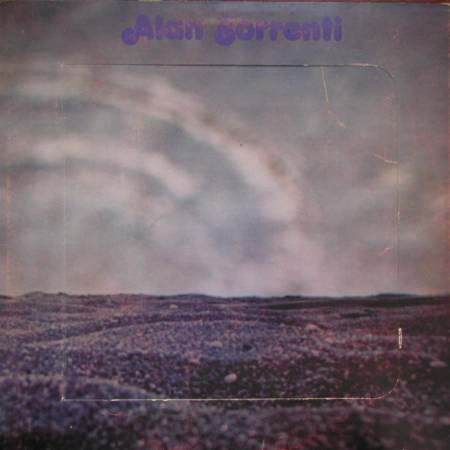
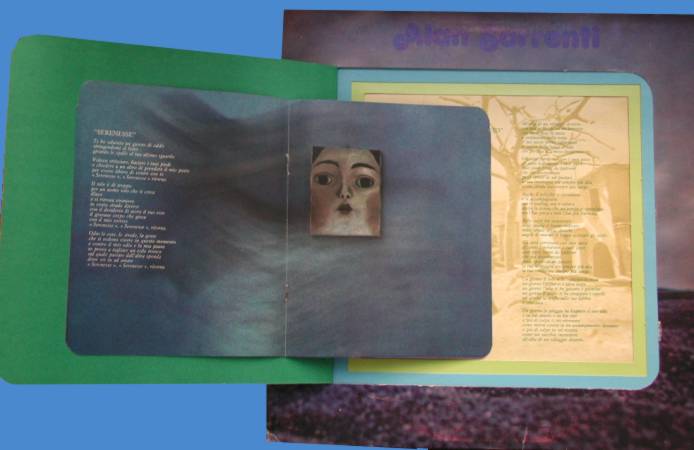
Come un vecchio incensiere had a small 12-page booklet with the lyrics glued to
the LP. It's difficult to find this intact.
Along with the main foreign guests, a double bass player named Ron Mathienson is mentioned on the cover: it's likely that he was british jazzist Ron Mathewson, who played in his long career with Ronnie Scott, Stan Getz, Gordon Beck, Ian Carr and many others.
The third album, Alan Sorrenti, has a much simpler design than the others, a single cover with lyric inner. The record intially had a round hype sticker on the shrink, which is often lost, with the thext "contiene Dicitencello vuje". Early copies of the record were pressed with a smaller label, of the size used on the singles (8,5 cm diameter instead of 10), later replaced by a standard one.
The early production of Alan Sorrenti was reissued on CD in 2018 by Universal (cat.no.60256 75623 99) in a box set entitled The prog years, which contains the first four albums (but the fourth, Sienteme, it's time to land from 1976 is very hard to describe as a prog record) and a four disc featuring alternative English language versions, demo and singles tracks all coming from the first period. While this bonus CD, Prog rarities, is only sold with this box set, the other four, all having a mini-LP cover, were also available separately.
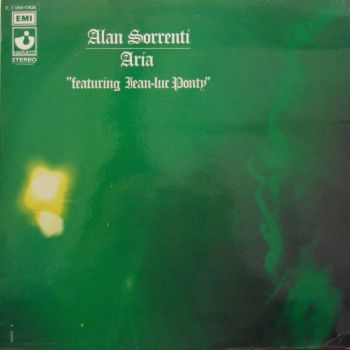
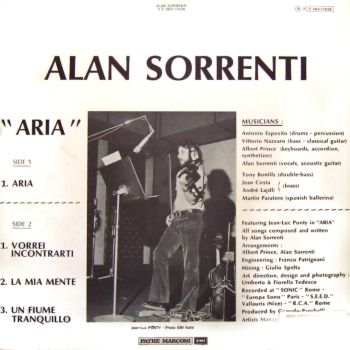
Aria was also released by Harvest in 1973 in France (and probably also in Germany) with a totally different single cover, giving much relevance to the presence of Jean Luc Ponty. The back of the cover contains a large picture of Ponty, very popular in France at the time, whose name is also on the front cover, and no picture of Alan!
No counterfeits exist.
The single Le tue radici, despite having a catalogue number lower than Dicitencello vuje was released later, in 1975.
As it happened with Saint Just,
one of the Sorrenti singles, Una luce si accende, has on the back cover
the writing "l'unico ed autentico progressive italiano" (the only real Italian
progressive), probably the first time that the word "progressive" was used
in Italy instead of the more common "pop" during the 70's.

 |
|
|
Aria - gatefold cover |
|
|
|
|
|
Aria - French issue LP, front and back |
|
|
|
|
|
Come un vecchio incensiere.... - LP - the centre of the cover can be opened as a booklet |
|
|
|
|
|
Come un vecchio incensiere.... - open cover with booklet |
|
|
|
|
|
Alan Sorrenti - LP |
|
|
|
|
|
Alan Sorrenti - small and regular label |
|
|
|
|
|
Vorrei incontrarti - 7" single cover |
Una luce si accende - 7" single cover |
|
|
|
|
Le tue radici - 7" single cover |
Dicitencello vuje - 7" single cover |

Thanks to Alos, Peppe Carrese and Lorenzo Pittan of Amarcord for some pictures and information